Welcome back! Last week we shared some bird language stories about the shapes of alarm.
Hopefully you had a chance to get out for a bit and start listening for the “broad strokes” of bird language – noting the areas on the landscape full of song; any quiet areas; and any areas with sentinel behaviors or repetitive call notes (possible alarms).
Mapping as a Routine to Deep Connection
Sometimes the actual mapping process can teach you the most about what you experience in the field. The act of mapping helps you see the landscape from a larger perspective. A deeper story about what happened may emerge for you through the map as you recall the sequence and location of events.
At the annual California Bird Language Intensive, we work with this mapping and diagramming approach to unlock the ‘secrets of bird language.’
 Participants engage in a group bird sit, debrief process, and group mapping each day. This group debrief methodology is shared in detail on the Bird Language with Jon Young DVD. You can also experience this process at a Bird Language Leaders event. Check the calendar to see what’s happening in your area.
Working with a group can really speed your learning process – it helps to have more eyes and ears on the landscape! Still, there is a lot you can pick up on your own, especially if you get out regularly to the same place.
Adopt a Place on the Landscape to Observe
If you end up sitting a lot in the same place each week, over time you will really start to get a sense of the patterns that occur there. You will start to develop some really deep questions about the landscape.
You might start to hear the same bird alarm sequence every morning, around the same time in the same thicket:
…A junco hooks up to chest height, and starts giving its short soft alarm note, and then a few seconds later, further down the thicket, a song sparrow hooks up to the same height and gives a short alarm.
By hearing and seeing this sequence over and over, you might start to wonder if something is moving through the thicket every morning. If you ever crawl into the thicket, just out of sight, you just might find what trackers call an “animal run,” a path in the soil worn smooth by the repetitive, routine passage of animal feet.
Tracking is the Other Half of Bird Language
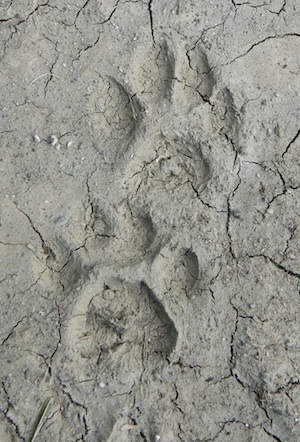
Perhaps on this well-worn animal run, you’ll find a scat (animal dropping) filled with raspberry seeds or rabbit fur, or even find a clear dog-like track with four toes and sharp thin claw marks. Who left the tracks?
Suddenly the other half of learning bird language, wildlife tracking, begins to awaken in one’s curiosity.
What animal could fit through the tiny opening in the thicket? Was it a fox? Where did it go to catch the rabbit? Could I see this animal?
These kinds of questions start to emerge.
Through these kinds of clues and questions, you will start to get a sense of who is living in the neighborhood. By honing your tracking skills, you can start to deduce who might be causing some of the bird language events in your area.
The book Animal Tracking Basics by Jon Young and Tiffany Morgan outlines some very effective routines that will help expand your tracking abilities. Just as the journey of learning bird language can benefit from practicing a set of “core routines”, so does the art of tracking.
The methods in that book, in conjunction with a good field guide to animal tracks, will give you some strong foundations in the art of tracking. Such a study will add many new layers to your bird language experiences.
Paul Rezendes’ Tracking and the Art of Seeing is a very accessible identification guide for beginners; Mark Elbroch’s Mammal Tracks & Sign: A Guide to North Amercian Species is the most comprehensive for identification purposes; James Lowery’s The Tracker’s Field Guide contains helpful behavior and track interpretation information.
Adventure of the Week:
This week, get out and look for tracks and other signs of wildlife in your favorite bird language observation and bird-watching area. Footprints, scratch marks on trees, scats, worn-in runways, and feeding signs are all waiting for your discovery. Such things can even be found in the heart of the city!
Footprints often are found in pockets of dust along trails, or in places where silt is washed out, or even where animal has stepped from mud onto concrete. Creek-sides are excellent places to look. The sharp hoof prints of deer can even be felt with your hand by pressing under the fallen leaves along forest trails.
Do This:
-Find some clear mammal tracks in a good substrate. Practice drawing tracks in your field journal. Note the number of toes, the presence or absence of claw marks, and the length and width of the tracks. All of these pieces of information can help you when using a tracking field guide for identification.
-Observe your birding area for animal “runs”, worn in pathways that are used repeatedly by different animals. Make a general map of any runs or other signs that you find. This will come in handy as a reference for when you hear bird alarm sequences in the field.
Resources:
Animal Tracking Basics. Jon Young and Tiffany Morgan. Stackpole Books, 2007.
Bird Language with Jon Young. DVD. Village Video and OWLink Media, 2011.
Mammal Tracks & Sign: A Guide to North American Species. Mark Elbroch. Stackpole Books, 2003.
The Tracker’s Field Guide. James Lowery. A Falcon Guide, Globe Pequot Press, 2006.
Tracking and the Art of Seeing. Paul Rezendes.